Pages

Showing posts with label Fase2. Show all posts

Water analysis after 3 weeks on both Aquariums ' ELOS Addicted

Source: FaaoAquascaping by Filipe Oliveira

After 3 weeks of setup and without any water's change during this period, I did all the tests to both aquariums to know how the water is. I did also the same tests to my TAP water to get a better comparison between both tanks and see if there is any oscillation on water's parameters.

Usually I do an water change per week of 20~40% depending of the stage of each aquarium, but this time I decided to do some tests because I setup the both tanks at same time but in different methods. I waited 3 weeks to see what have changed and if the fertilization's routine is right or need to be changed. Plants are growing very fast, invertebrates and fishes are healthy and till now, no signs of algae... At first appearance, everything seems to be ok!

The 60L Aquarium was setup with new products and with a different soil, the ELOS BlackMedium. I was expecting, even using ELOS AquaUno (provide bacteria and accelerate biological process reducing the nitrogen cycle) the normal water's cycle, high levels of Nitrates and some algae, but the values were optimistic; 10~25ppm of NO3 in this Aquarium.
On 350L, no nitrogen cycle, I didn't used recycled water from previous layout; I only used the recycled filters and AquaUno. I was a little bit concerned with the fact of mixed all the soil (it was reused from previous layout) that could release some ammonia due keeping it for more than 24 months on previous layout; but no signs of it; NO3 is on minimum 1ppm, NH3/4 (Ammonia) 0~0,1 (it is nothing) and Nitrites also Zero!!! WTH!!! For an aquarium with 3 weeks without any water's change and feeding the discus with frozen food, I was not expecting such good results!
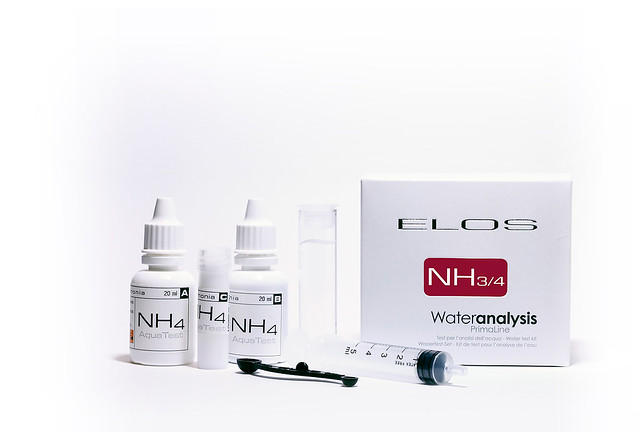
Ammonia TestKit
Awesome news, both soils don't release Ammonia to water's column! I already knew that ELOS Terra Brown Soil didn't do it, but I would like to see with my own eyes and through tests that BlackMedium Soil from ELOS didn't do it also!!!! Both soils are Ammonia FREE!

Here they are the results of all tests that have done to both Aquariums and a comparison to my TAP water:
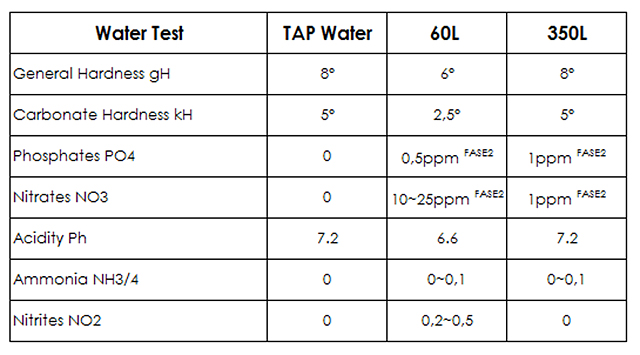
Water Test Aquariums @3rd week
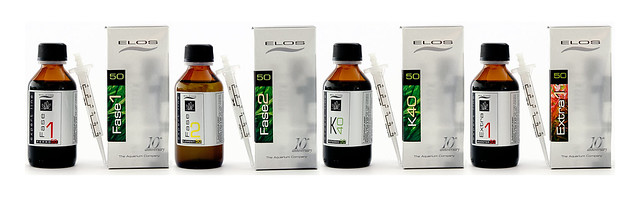
During these 3 weeks I'm fertilising with ELOS Expert Line Fertilisers, FASE1, FASE2, K40 and also Extra1.

Dosing of Expertline fertiliser and schedule routine:
On my small aquarium (60L) twice a week with 0,5ml of FASE2 and Fase1 in separated days, exchanging Fase1 with Extra1 and K40 once a week diluted 1/3 of the bottle in 100ml of osmosis water.
On 350L Aquarium, almost the same routine but instead of 0,5ml of each, I'm using 2ml.

Conclusion:
Both Aquariums are healthy, the plants are growing very fast, and I need urgently to do an water's change, specially on 60L to reduce NO3 levels and keep the parameters similar to 350L.

Maybe I need to increase a little bit more the dose of FASE2 on my small aquarium to balance PO4 near of 1ppm... my comfort zone ;-) I guess that 1ml + 0,5ml of FASE 2 per week will be enough, just because all the plants have fast growing, otherwise, It was just fine like it is ;-)

Special note for BlackMedium soil, what a great soil! I never had the water so crystal on my aquarium since the beginning till now... AMAZING!

Ps. All the water's test were done with ELOS WaterTest Analysis.

Expert Line Fertilisers by Filipe Oliveira

Source: Filipe Oliveira (http://faao.blogspot.com)

When we talk about ELOS, people usually associate with the brand the word ‘expensive’. Perhaps the size of each bottle, or the fact it contains only 100ml of liquid fertilizer compared to other brands, brings this impression of small and expensive. But is it really expensive? Let’s see…

ExpertLine_complete

Size doesn’t matter! What is inside is what really matters…
People like to buy in huge quantities and cheap; who doesn’t want this? But, are those products effective?

FASE1 (Chelated Iron) vs. Liquid fertilizer of X brand (Iron)
Today, people tend to look at the immediate price, rather than analysing the costs over the medium and long term. Obviously, if a product exists that costs half as much, then why waste more on any product of ELOS Expert Line? However the quality of the products and how long they last, has no comparison at all.

We understand that in terms of quantity, it is more acceptable for the end-user to buy two bottles of 250ml liquid fertiliser than to pay a similar price for only a single 100ml bottle of FASE1 for example. In fact, we have 500ml of liquid fertilizer of ‘X’ brand against 100ml of FASE1, which in terms of marketing is really fantastic… in theory is good, but are you saving money? Let’s see!

Some may have seen on TV a commercial for concentrated juice - how many cups of juice can you make with one simple bottle? Note that we are not discussing whether this is as good for our health or if it contains chemicals to preserve the product - we are only using this comparison in terms of concentration. But anyway, liquid fertilisers are chemicals!

Liquid fertilisers of ‘X’ brand are greatly diluted in comparison with Expert Line and this can be as much as 10:1 or 20:1, so in terms of practice we can simply obtain the following values for the best choice:
500ml of ‘X’ brand = 500ml / 10ml = 50 applications
100ml ELOS Fase1 = 100ml / 1ml* = 100 applications

*1ml of any ELOS Expert Line Liquid fertilizer treats 100Lt of water

Conclusion: to achieve the same water treatment in terms of how long a bottle lasts, we need 1L (4x250ml) of liquid fertilizer of ‘X’ Brand instead 100ml of ELOS Fase1, so rather than being half price it can actually be double the price of ELOS Fase1!

FASE2 (Micro and Macro elements) vs. individual liquid fertilizers (Micro + PO4 + NO3)
In this situation it will be more difficult for us to show the difference… or maybe not. A bottle of FASE2 costs about 50% more than FASE1, but in any case let’s see the difference and if we can be cheaper than other liquid fertilisers.

Say we will use an average of $/€10 per 250ml bottle of ‘X’ Brand.
Note: Liquid fertilizers of ‘X’ brand are much diluted in comparison with Expert Line and this can reach to 10:1 or 20:1, which in terms of practice we can simply obtain the following values on the best of choices.

2x 250ml $/€10 bottle of PO4 = $/€20
2x 250ml $/€10 bottle of NO3 = $/€20
2x 250ml $/€10 bottle of Micro elements = $/€20

Total for 1,5L of micro and macro elements= $/€60
ELOS Fase2 100ml = approximately half that price

Using the recommended ratio of 1:10 or 1:5 (PO4:NO3) 1ppm of PO4 for each 5~10ppm of NO3, we have the following values:

Fase2 100ml = 100ml / 1ml* = 100 applications
500ml PO4 = 500ml / 10ml = 50 applications
500ml NO3 = 500ml / 5ml = 100 applications
500ml Micros = 500ml / 5ml = 100 applications

*1ml of any ELOS Expert Line Liquid fertilizer treats 100Lt of water

Conclusion: to treat the same quantity of water we need to twice as much for ‘X’ brand compared to FASE2 - using ‘X’ brand we need 2,5Lt of liquid fertilizer… 2,5L!

How much would it cost per month to treat a 60L Aquarium using ELOS Expert Line Fertilizers?
Using guide retail prices for Europe:
Fase1 = €20 / 100ml x 8 applications/month x 0,5ml dose = €0.80
Fase2 = €30 / 100ml x 8 applications/month x 0,5ml dose = €1.20
K40* = €40 / 100ml x 4 applications/month x 0,5ml dose = €0.80

Note:
8 applications = 2 applications per week.
K40* = In case of the appearance of ‘green dust’ on glass the day after application, it is recommended to halve the dose in each application. That means that instead of €0.80, the cost will be reduced to €0.40.

€2.80 per month is really cheap to treat your planted Aquarium!

We don’t produce fertilisers containing 98% water, but we can provide concentrated fertilisers that can be diluted in water (RO Water) to reduce the concentration without loosing the properties. It is therefore much easier to fertilise every day or in more quantity and for half price!